MIP | AI in advertising: invisible to the viewer, indispensable for impact?
AI, the creative enemy? Or your secret advertising ally? If the critics are to be believed, the rise of AI spells the end of creativity in advertising. "Soulless," cry the loudest voices on X. But ask the Belgian consumer for their honest opinion, and you'll hear a very different story. New research from System1 and Kantar, combined with our own MIP data on the recent Coca-Cola Christmas campaign, shows that consumers don't lose sleep over what happens behind the pixels — as long as the story moves them. Curious how they pulled it off? We're taking you behind the scenes.
Coca-Cola's impressive numbers
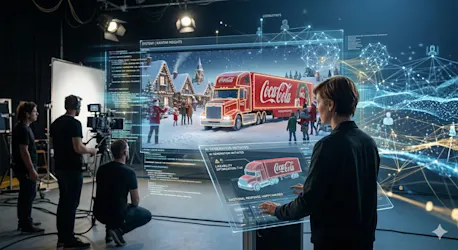
Despite all the backlash in 2024, Coca-Cola went ahead in 2025 with another fully AI-generated Christmas campaign. The results in our MIP study (Media Impact Posttest) speak for themselves. With a likeability score of 7.49, the drinks giant achieved the 4th highest score of all video campaigns tested in 2025.
Coca-Cola
The strong likeability went hand in hand with impressive impact results:
Strong emotional response: The ad scored exceptionally well on the emotions 'enjoyment' and 'happiness'.
Brand recognition: A near-perfect attribution of 93% proves that the use of AI did not stand in the way of recognisability.
Activation: The campaign succeeded in generating talkability for the brand during the busy end-of-year period.
What consumers don't know doesn't hurt them
So why all the fuss? System1's research reveals a fascinating paradox: consumers simply cannot identify AI ads unless you explicitly tell them. Only 24% of viewers spontaneously describe an AI spot as 'digitally generated'. The majority find it looks like a typical, professional advertisement.
Even more striking: once people know it's AI, this barely affects their emotional appreciation. In fact, System1 found that AI-generated ads produce a stronger emotional response on average than regular ads.
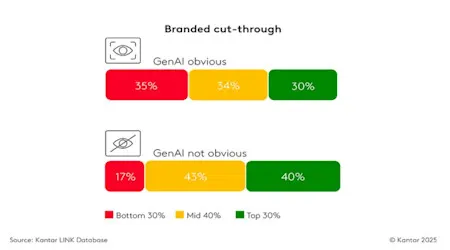
Execution quality, however, plays a crucial role. System1 and Kantar found that the impact of an AI ad stands or falls on its 'seamlessness'. The moment visual imperfections creep in — people who look 'almost' but not quite real — the technology becomes a distraction. The human brain unconsciously focuses on what is 'wrong', causing emotional transfer to stall and the brand message to lose its power. Campaigns where the use of AI is not in your face score a stronger impact on average (Branded Cut-Through, in Kantar's terminology). The strength of the Coca-Cola case was precisely that the AI execution was fluid enough for the average consumer not to break the Christmas magic.
Recognisable brand identity as the biggest challenge
A second key pitfall is that AI has no innate understanding of your brand identity or the elements that make your brand unique (Distinctive Brand Assets). AI needs to be deliberately trained and guided to use the right tone of voice and unique brand elements. Without those elements, the extra emotions your campaign generates are wasted — because they won't be associated with your brand. A market leader like Coca-Cola is easy to recognise; for smaller brands, this is even more decisive.
3 takeaways for the Belgian marketer
The successful Coca-Cola case in MIP shows exactly how it's done. Want to experiment with AI yourself? Keep these three principles in mind:
Keep humans in the driving seat: AI is a production tool, not a strategist. The best results come from combining AI speed with human creativity. AI is meant to "expand the toolbox", not replace craftsmanship.
Anchor your brand identity: Coca-Cola succeeded because their recognisable red trucks and Christmas iconography remained front and centre — AI or no AI. Train the AI on your specific brand style.
Make it seamless: The less the use of AI stands out, the greater the impact. An ad that distracts on a technical level loses impact.
Curious how your (AI-)campaign really performs with Belgian consumers?
We'd love to test your creative in our weekly MIP study to map its emotional impact and distinctiveness with pinpoint precision. Get in touch with your DPG Media Advertising contact for more information.