
Why brand awareness is the heart of successful advertising
Is your brand still healthy?
A brand, much like a person, needs to keep a close eye on its health — to protect itself and keep growing. For a person, the key parameters are height, blood pressure and cholesterol. For a brand, they include name recognition and consumer attitudes. Brand awareness is the most crucial KPI for monitoring your brand's health. If nobody knows your brand, they're unlikely to buy from you.
Yet not every marketer makes full use of brand awareness as a benchmark. We're here to guide you through the different measures of brand awareness and show you how to use them to strengthen your market position.
Measure what matters
There are three key metrics for tracking brand awareness. Each one measures a different aspect of consumer consciousness in relation to product categories.
TOM (Top of Mind): the first brand that spontaneously comes to mind in a given category;
Unaided awareness: all brands mentioned spontaneously — without any prompting — in a given category. In other words, every brand a consumer recalls on their own.
Total awareness: based on a list of brands in a category, asking which ones the consumer recognises by name.
These indicators measure how accessible your brand is in consumers' memory — with TOM being especially important for established brands, while Total awareness applies to all brands.
It is also worth gaining insight into the brand awareness among non-buyers, because that is where the growth potential lies. We see that declining brands are precisely those that fail to attract enough new customers.
Knowing how many people recognise your brand is essential — but so is understanding where you stand relative to the competition. For leading brands, their position against direct competitors matters enormously. Being the first brand mentioned in a category is a strong indicator of short-term memory recall, and since 90% of all our decisions are made unconsciously, this is simply not something you can afford to overlook.
What's next?
To put this theory into practice, let's walk through a few examples.
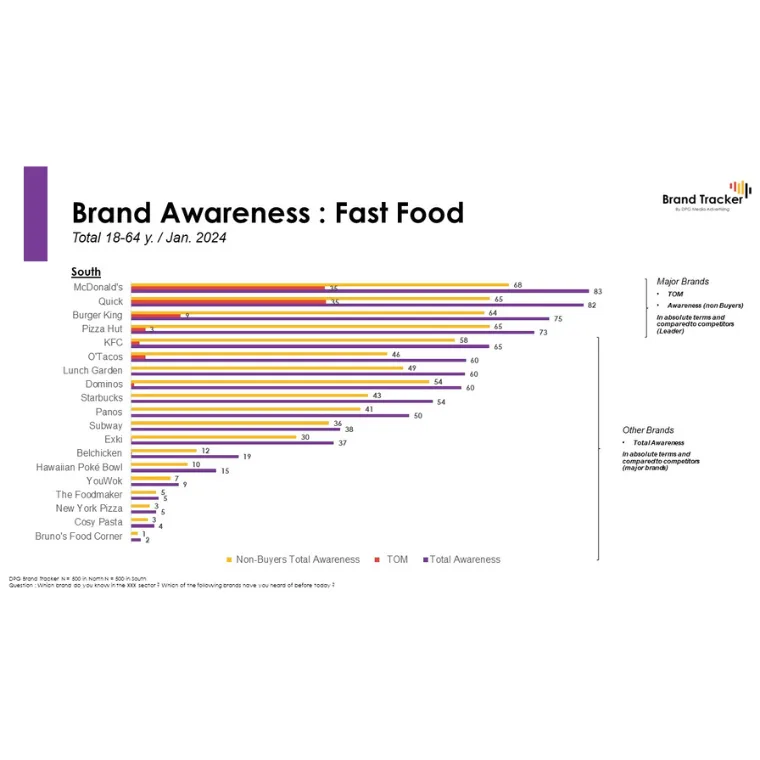
Within the Fast Food sector in the South, McDonald's and Quick are battling it out for the top spot in Total Awareness and TOM (Top of Mind). In this example, McDonald's has stronger name recognition among non-customers — which means greater growth potential than its direct competitor.
Burger King and Pizza Hut have lower overall awareness, but do register with their non-buyers.
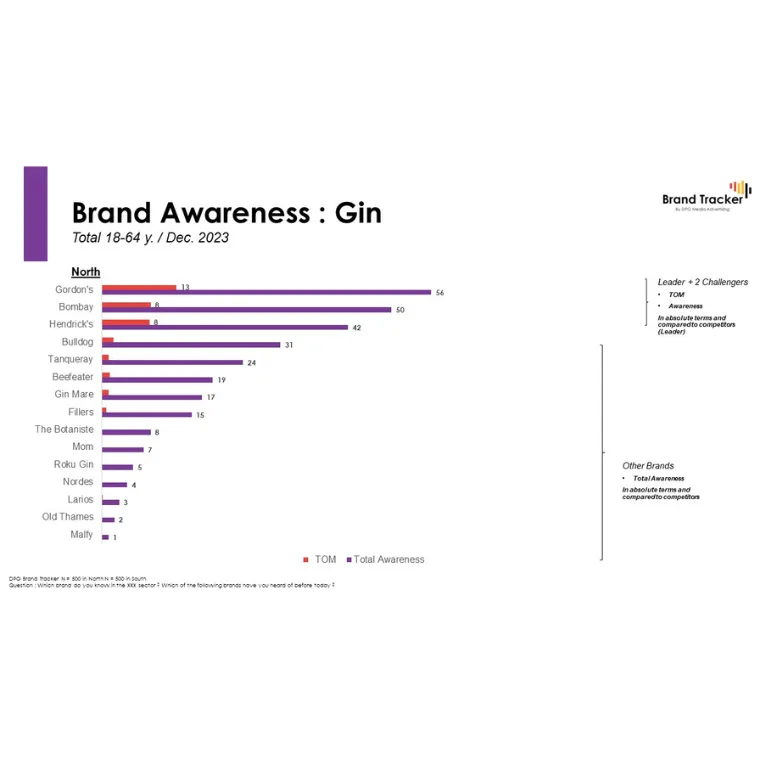
Within the Gin sector in the North, Gordon's leads the category with a Total Awareness of 56%; 13% of Flemish consumers (aged 18–64) name it first. Despite that leadership position, challengers such as Bombay and Hendrick's are close behind with comparable overall awareness levels.
These examples are, of course, a snapshot in time. It would be valuable to continue this analysis over a consistent period to track changes. What really matters here: if a brand has high top-of-mind (TOM) awareness among its current consumers, that reinforces loyalty — but high TOM among non-buyers is likely to be far more lucrative for the brand.
So as a company, you simply cannot afford to lose sight of your brand awareness. Repeating distinctive brand elements strengthens long-term memory with consumers. You need to continuously optimise your campaign plan to reach as many buyers and non-buyers as possible. With tools like the Brand Tracker by DPG Media Advertising, it's now possible to keep a precise finger on the pulse of your brand — so that when the next push is needed, it's not a shot in the dark, but a well-considered move towards success.
Want to stand out from the crowd, sharpen your marketing strategies, and truly connect with your target audience? Get in touch with our Research Team. They'll be happy to help you move forward.